






Imagine you’re sitting in the dentist’s chair and you’ve just been told you need a root canal and a crown. The estimate? More than $2,000. And then the light bulb goes off. Should you apply for dental insurance?
That’s a good question, and one millions of Canadians wrestle with every year. Dental care is not covered by Canada’s public health system, unlike visits to the doctor or hospital stays. That means the cost of keeping your teeth healthy is mostly up to you.
So is dental insurance worth it in 2026? The answer depends on your teeth, your budget, your employment situation, and whether you qualify for new government programs like the Canadian Dental Care Plan. In this guide, we’ll break down exactly how dental insurance works, what it covers, what it costs, and how to figure out whether it makes sense for you.
How Does Dental Insurance Work in Canada?
Unlike medical care, dental care isn’t covered by Canada’s public health system. Most Canadians either pay out of pocket or get dental insurance through their employer or a private provider.

In simple terms, you pay a monthly or yearly premium, and the insurance helps cover part of your dental bills. Most plans cover preventive care like check-ups, cleanings, and X-rays, plus basic work like fillings and extractions. More comprehensive plans also help with crowns, root canals, dentures, and braces.
Dental insurance usually works on a split-cost model. For example, a plan might pay 80% of a dental filling and 50% of a dental crown, leaving you to cover the rest.
There are also limits. Many plans have yearly caps on what they’ll pay. Some have deductibles you need to meet first, or waiting periods before major work is covered. Always read the fine print.
What Dental Insurance Covers in Canada
Dental insurance coverage in Canada depends on your primary source of coverage: the new federal Canadian Dental Care Plan (CDCP) for eligible individuals, private insurance often provided through employers, or provincial health plans. Here’s a breakdown of what each covers.
Basic Services
Fillings, tooth extractions, and simple root canals are considered basic dental care and are usually covered at a percentage between 60% and 80%, so you and the insurer share the cost.

These treatments restore function and prevent further damage to common dental problems such as cavities or minor infections.
Preventive Care
Regular check-ups, cleanings, and routine X-rays are considered preventive care and are usually covered fully or at a high percentage (typically 80–100% covered). Regular appointments also help dentists to identify problems early on, meaning less invasive procedures later on.

Major Services
Crowns, bridges, complex root canals, dentures, implants, and oral surgery are all considered major procedures. Some plans cover these, but at a lower percentage, and there is typically a waiting period to qualify.
These are covered at a lower percentage (usually around 50%) and may demand pre-approval from the insurance company.
Orthodontics
Family dental insurance sometimes covers orthodontics like braces and retainers, but usually only for children.
Most basic plans do not cover cosmetic services like bleaching or veneers. Annual maximums typically range from $1,000 to $2,000 per person.
Your Dental Insurance Options
You can get dental insurance in three ways: through an employer group plan, a private individual plan, or government programs for seniors, kids, or low-income households. Which one’s best depends on your needs and budget.
1. Employer Group Plans
This is the most common option. In Canada, employers provide dental insurance to over 60 percent of the population. If you have a job that offers benefits, dental is usually one of them. Miller Dental Care
Workplace benefits generally cover routine preventive care, like checkups and X-rays, and restorative services, such as fillings. Many employer plans also cover major work like crowns and bridges, and some even cover orthodontics, especially in the higher benefit tiers.

The main advantages over buying on your own is that premiums are often shared with your employer, making them cheaper out of pocket, and employer-sponsored group plans may have shorter or no waiting periods for major procedures. You’re also covered as part of a group, so there’s usually no medical underwriting, meaning pre-existing dental conditions won’t be held against you.
One thing to know: any level of dental coverage offered by an employer, including health spending accounts, is considered access to dental coverage, even if you opt out. This matters because it automatically disqualifies you from the government CDCP program.
2. Private Individual Plans
If you’re self-employed, retired, or your employer doesn’t offer dental benefits, you can buy a plan on your own through insurers like Sun Life, Manulife, Canada Life, or Blue Cross, etc.
Individual dental insurance is a private plan you pay for yourself or with your family. Unlike group or employer-backed insurance, you pick the plan that fits your needs, and often you can choose your dentist. These plans vary widely in cost, coverage levels, limits, and network rules.
3. Government Programs
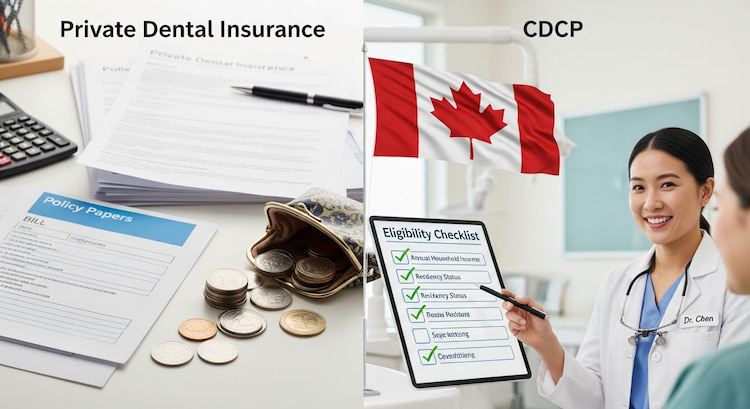
If you’re a Canadian without private or employer coverage, there are public options, chief among them the Canadian Dental Care Plan (CDCP). We have compared the CDCP with private dental insurance in a previous blog post titled CDCP vs private dental insurance.

To qualify for the CDCP, you must be a Canadian resident, have filed your taxes last year, have an adjusted family net income of less than $90,000, and not have access to dental coverage through private or employer sources. No payment for those earning less than $70,000; co-payment is 40-60% for those earning $70,000 to $89,999.
How Much Does Dental Insurance Cost in Canada?
The cost of dental insurance in Canada varies significantly, typically ranging from $60 to $150 per month for an individual and $150 to $350 per month for a family. However, your final cost will depend on several key factors.
Here’s a breakdown of average monthly costs based on the type of plan:
| Plan Type | Estimated Monthly Cost |
| Individual (Basic) | $40 – $60 |
| Individual (Comprehensive) | $75 – $150 |
| Family (for a family of 4) | $110 – $400 |
| Seniors (65+) | $100 – $300+ |
The actual cost is determined by these main factors:
- Coverage Level: Basic plans are cheaper. Routine care (cleaning, x-rays), major procedures such as crowns, root canals, and dentures cost more.
- Your Age and Location: Premiums generally increase with age and the cost can vary by province because each dental association sets different fee guides for procedures.
- Plan Details: If you select a plan with a lower monthly premium, the deductibles could be higher, the annual maximums could be lower (say, $1,000 vs. $2,500), or the payout rates could be lower (say, 50% vs. 80%). This could cost you more in the long run.
So, if you need regular dental work or expect big expenses, insurance can save you money. But if your teeth are in good shape, paying as you go might be cheaper.
Does the Canadian Dental Care Plan (CDCP) Change the Answer?
Yes, the CDCP dramatically changes the cost picture for those who qualify. The short answer is that it’s a partial-payment plan, not a completely free dental plan, and it adds a few key layers of cost to be aware of.
If you’re a Canadian who qualifies (meaning you don’t have private insurance and your family income is less than $90,000), the CDCP will cover a percentage of the fees based on your income. But coverage is seldom comprehensive.
The 4 Eligibility Requirements are:
- You are a Canadian resident for tax purposes.
- You filed your tax return for the previous year.
- You do not have access to private dental insurance (including through an employer, pension, or family member).
- Your adjusted family net income is less than $90,000 per year.
Read the full CDCP guide here: Who Qualifies for the CDCP? A Simple Guide for Patients (2026)
Typical Dental Costs in Canada
In Canada, there’s no fixed price for dental care; it’s a recommended-price system for each province. This means the amount you pay can vary a lot depending on where you live, what kind of treatment you need, and if you have insurance or not.
Here is a look at the estimated cost range for common procedures in 2026:
| Common Procedure | Estimated Cost Range (CAD) |
| Checkup, Cleaning, and X-rays (Routine visit) | $200 – $450 |
| Cleaning (Scaling and polishing) | $150 – $400 |
| X-rays (Per image) | $23 – $60 |
| Composite Filling (One surface) | $150 – $300 |
| Root Canal (Varies by tooth) | $600 – $1,500 |
| Crown | $1,000 – $1,700 |
| Dental Implant (Single implant and crown) | $3,000 – $6,000 |
| Full Dentures (Complete set) | $1,500 – $3,000 |
| Wisdom Tooth Extraction (Simple, per tooth) | $150 – $350 |
Keep in mind these are estimates; prices tend to be higher in large cities like Toronto and Vancouver.
How to Choose a Plan if you Decide it’s Worth it?
Once you’ve decided dental insurance is right for you, the next step is choosing a plan that actually fits your life. Not all plans are created equal, and the cheapest premium isn’t always the best deal. Here’s how to narrow it down.
Start with your actual dental needs
Look at your history. If you rarely need more than cleanings and the occasional filling, a basic plan with strong preventive coverage may be all you need. But if you have crowns, root canals, or know major work is coming, focus on a plan with good major-services coverage, even if the premium is more expensive.
Check the coverage percentages and annual maximum
A plan that covers 80 percent of basic care, but only 50 percent of major work, will still leave you footing a big chunk on expensive procedures. Add that to the annual maximum, a $1,000 cap goes quickly if a crown is needed. If you think you’ll have a lot of work, then look for a higher maximum, even if it costs more per month.

Read the fine print on waiting periods and deductibles
Many individual plans make you wait six months to a year before covering major procedures, which matters if you need work done soon. Deductibles also eat away at value, so consider them in your real out-of-pocket cost, not just the premium.
Confirm your dentist
Some plans restrict you to a network or reimburse based on a set fee guide. If you’re attached to your current dentist, make sure they fit the plan before you commit.
Do the simple math
Add in what you expect to pay in annual premiums and compare that to what you would actually spend if you paid out of pocket. If you’re just after routine care, it’s often cheaper to pay as you go. If you’re expecting a year of fillings, a crown, or orthodontics for a child, insurance can pay for itself many times over.
Don’t overlook government options
Before you buy a private plan, check to see if you’re eligible for the Canadian Dental Care Plan. If you can get coverage from your employer, even if you decline it, you’re not eligible. But if you’re self-employed or retired with a family income under $90,000, the CDCP could cover a large part of your costs with little or no premium.
One Last Thing
Dental insurance is worth it when your expected dental costs exceed what you’d pay in premiums and out-of-pocket expenses combined. For people with ongoing dental needs, growing families, or upcoming major work, a good plan offers real savings and peace of mind.
If you have good teeth and little history, then saving for routine visits and seeing if you qualify for the CDCP may be the better financial option. Finally, the right choice depends on the individual. If you have any questions, feel free to ask our team at Kawartha Dental Clinic. We are here to help you.